Easy Way to Remove Silt From a Garden Pond

If at that place'southward lots of silt, heavy equipment must be able to get underneath it, silt needs to exist dry enough to mix and move with other soils, then it tin be removed.
By Bob Lusk
After reading that headline, the offset question you should ask is, "Why is a fisheries biologist writing virtually silt?"
The respond, "Because he's scraped a off-white share of that gooey stuff from under his toenails over the years." Plus, he's been stuck mid-thigh deep in a quagmire of swimming muck. That qualifies, doesn't it?
All kidding aside, for the moment, and to quote a longtime friend, Forrest Gump, "Silt is every bit silt does."
Silt, by definition, is stone, mineral or dirt fragments 1/xx millimeter diameter or smaller. These tiny pieces of geologic wonder are easily moved by h2o flow and quick to settle once the movement stops, depositing itself in waves where the water slows.
When a swimming or lake is built, siltation begins with the kickoff pelting, especially when that precious moisture stuff falls from the sky onto freshly disturbed soils. Adjacent time yous drive by a new pond…or a freshly renovated old one, look at the ruts cascading from height to lesser where h2o sought its path of to the lowest degree resistance. What was in those ruts now sits less than contentedly beneath the surface of that water body or deposited somewhere downstream of its prior resting spot.
Over time, silt deposits tin completely change the landscape. If y'all don't believe me, ask New Orleans. If it weren't for the biggest river in North America depositing its silt on the downstream side of Louisiana, New Orleans might have been settled just south of Minneapolis.
When a pond or lake is first built, information technology has a life span. Accept, for example, the thousands of flood prevention sites built by the Federal Government in the countryside around cities in the late 1950's through the early on 1970'south. These dams were purposely overbuilt for each site, tall, direct, with lots of compacted soils, with the sole purpose of relieving pressure on nearby rivers and streams. During that era, the mission was to stop flooding in expanding cities and suburbs. Each dam was designed to capture excess menstruation from behemothic rain events and then slowly, precisely, release that roiling water in an orderly manner. That'due south what they do. Each of those reservoirs was built to have nearly a l to sixty year lifespan. Fast frontward to now and that's exactly what'southward happened. Their lifespan has concluded. Each i has tons and tons of silt. As a professional person fisheries biologist and lake direction consultant, I take the distinct pleasure to meet with happy new landowners on their recent purchases to discuss what to do with these lakes-on-their-final-legs, and then to speak. Typically, they'll inquire, "What do we need to practice to make this a proficient angling lake?" Even though I don't show information technology, my whole body winces inside. Might equally well ask me how to make Tiger Wood into a preacher. It could happen, simply nosotros'll need some pretty potent divine intervention.
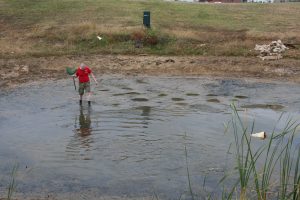
Ever walked in thigh-deep silt? Don't do information technology.
Most of these bodies take impressive dams…and when nosotros drive atop the dam to run across the lake…voila', at that place information technology is, a massive earthen structure which yields to a flat plane of shallow, muddy h2o, typically with an average depth of two to three feet beneath the surface. Less than impressive…unless you wanted a flood prevention lake.
Even small ponds have this dilemma. Over time, Nature being what it is, ponds and lakes receive a portion of silt. It'southward that "lifespan" matter.
At that place were literally millions of ponds and lakes congenital with heavy equipment all over the U.s. during the last fifty to sixty years. Millions of them. Some estimates today claim there to be 4.5 one thousand thousand individual ponds and lakes dotting the landscape of our fair land. Other estimates push that number beyond 6 million. Each of those ponds has a lifespan, the length of which primarily determined by how much silt flows in, and how fast, to fill that hole and turn it from a swimming to a marsh to dry land again.
Inevitably, the questions are now turning to, "How can nosotros get this silt out of my pond?"
The best first answer is, "Should yous?"
Ask that question, start. And then, figure out the all-time methods to remove silt…if it makes good sense. For example, if you live in an urban surface area where ponds are the focal point of a neighborhood and a homeowner'south association runs your evidence, removing the silt could make sense on a diverseness of levels. Quite a few developments were congenital around existing ponds and lakes which had already outlived one-half their lifespan. When the homes were built, if expert construction practices weren't properly exercised, even more than siltation occurred, reducing the pond's lifespan even quicker. Odds are property prices are heavily influenced by that shining water body behind your house. Expect at removing silt to continue property values upwards. No i wants to alive beside a mosquito infested, heavily vegetated, mud hole.
At the other stop of that spectrum sits a modest rural subcontract pond that was congenital in the 1960's for livestock water. Then many times, I'll hear from the new landowner, "I grew up nigh here and fished that pond when I was a kid. It was a great place to fish and swim back then." Today, that formerly pristine-looking retentiveness-filled swimming is nothing more than a silted in, cattail covered marsh, with a pot of water in the centre. The dam is covered with scrub trees and the swimming is well past its prime number, on its way to pasture. That landowner wants to explore reviving this pond to its former luster…and take information technology teeming with giant fish. My first advice? See if we can build some other swimming somewhere nearby, preferably downstream.
Why advise that?
Simply because moving silt is tedious and expensive. We tin overcome that wearisome role, but the landowner must come up to grips with the expensive side. Simply speaking, removing silt from a pond entails moving the dirt at least twice, frequently three times. And, all you lot go is a cubic yard of water for every cubic yard of silt removed. That isn't really efficient. Building a new dam, you at to the lowest degree get to typically raise the water level and become lots more than water for the cost of construction. Merely, that's another story.
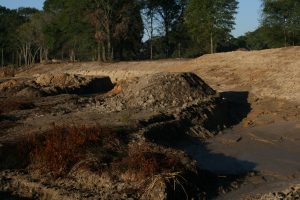
Some earthmover will pile it as information technology dries, then move the piles when drier.
Then, Task One is deciding whether or not to remove silt. If you lot exercise your homework and the decision is "Feasibility, yep" so you need to quantify how much silt to remove. That sounds similar an impossible chore, merely there are companies out there with the capability to calculate with some caste of accuracy merely how much silt lies at the bottom of your pond.
Hither'due south a story to aid understand the importance of this concept. I'll never, ever forget a fishing club where I consulted mode back years ago, in the late 1980'southward. They were in due north Texas, had a dainty 30-plus acre lake and six smaller ponds scattered over their 350 acre property. I pond was heavily silted, so the board of directors decided to remove the silt and bring new life to that two acre honey hole. They sought bids from local earthmovers. One guy bid $12,000, some other bid $xx,000, another said he wanted to cut the dam, take a look and then give a bid. A fourth guy said, "I ain't touching this chore considering we don't know how much silt there is." The depression applicant was called, simply considering the order knew they could get downstream and build a new pond for $20,000, so the $12,000 bid seemed similar a fair bargain to revive the older swimming. The crusty old clay man showed upwardly with a xl year old dump truck, a dragline that seemed older than he was and a bulldozer dripping hydraulic fluid. He cut the dam with the dragline and the pond drained. Best we could, we gathered the fish and moved them to another swimming. After the pond sat for several summer weeks, the dirt guy and his assistant went to work on the clay, when they weren't working on their equipment. About four weeks into it and with half the pond bottom looking adept equally new and the other one-half still up to six feet deep in cracked silt topping with black pudding-like muck below that surface crust, the earthmover chosen the board president for a quick coming together. "Mr. President, we take a trouble." The president, with one eyebrow cocked up a fiddling bit said, "Oh?" The earthmover spit tobacco juice, pawed at the ground with his right pes, ducked his head a footling chip and surmised, "There'southward way more silt in here that I thought. You boys should've told me that before the bid." The president wasn't as well eager to hear this story, for practiced reason. The earthmover went on to explicate that he'd gone deeper into the soils than he might have needed, but he was getting to the stop of the money and wasn't going to exist able to stop the projection for the bid he'd permit. He gave the club a couple of options. Either they pay him by the hour until he finished, or he'd have to quit and get out the pond equally is. The board conferred, and for some strange reason, paid more than money. But, they fabricated him concur to another dirt work before he left, gratis. At the end, the project was over time, over budget and was such an irritant to the members that the president lost his job. And…in that location was a large pile of silt left about 200 yards from the pond…not by pick destined to become the new shooting range.
Today, holding owners or managers can hire a company for a reasonable fee to come in with sophisticated sonar equipment and map the pond lesser and get a good judge of how much silt at that place is. With that map, a manager can project the cubic yardage of silt to exist removed, how deep it is, where information technology sits on the swimming bottom and then receive educated, accurate bids to remove the gooey stuff. Then, a more intelligent decision tin can be made.
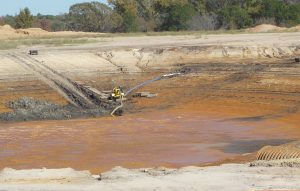
Silt is a wet, mucky, gooey mess.
How's the best fashion to remove silt? Talk to some earthmovers and they'll tell you to cut the dam, drain the pond and let it sit for months to dry upward as much every bit possible. Those are the guys with bulldozers who have to push dirt to make a living. Other earthmovers suggest removing the water, and then go far there with a trackhoe or a bucket loader and beginning at the edges and dig it up, load into trucks and haul offsite. All the same others with a different train of thought propose leaving the water in, bring in a dredge on a barge, till that stuff up and pump it to its final resting place or a big bin to be hauled abroad. Another idea is to merely heighten the former dam to increase swimming depth and not worry about the silt. I've seen several projects where the landowner decided to remove only the silt effectually the periphery of a swimming and get out the deepest muck where it sits. At that place are a number of means to skin that silt-laden pond. You, being the pond owner, must decide what the best way is for you, based on your mission…and your bag. Oh, and be certain to check and meet if you lot need any permits.
With a rural pond, it might make the near sense to de-water, mix the silty soils with the dry soils beneath, ringlet it, pulverize all-time y'all tin and button it over the existing dam and spread it out as the new back-side slope. It might make the near sense to dig with an excavator, mix with dry soils, and load into a dump truck and booty it off site. And, it could make sense for that excavator to dig, spin and make piles on the shoreline to spread and distribute later, when those pudding-similar soils dry upward enough to move.
Here's the bottom line. Silty ponds are common today. Removing that silt may make sense, it may not. If it does make sense, do your due diligence to decide the best methods to move and dispose of the material. After all, y'all don't want to get half-way into the project and decide it made more than sense to leave nature to exercise what nature does with that silted-in swimming.
Source: https://americansportfish.com/removing-silt/
0 Response to "Easy Way to Remove Silt From a Garden Pond"
Post a Comment