When Can You Tell a Baby's Hair Color
Have you been waiting anxiously to notice out what hair colour your newborn will accept? It's normal for any expectant mom, maybe even earlier the positive test, to wonder what your little i will await similar.
You already know that your baby will resemble you in some means. Only then we must also take into consideration how much influence your partner'southward genes volition have. Babies are like 3D copies of mom and dad merely in a smaller (and cuter) package.
In this guide, we'll talk over what determines baby hair colour, any influencing factors, and when it becomes permanent.
- Can We Predict Baby'due south Pilus Color?
- What Determines Baby's Hair Colour?
- Could My Babe's Hair Color Change?
- Unique Hair Colour
- Hair Today, Gone Tomorrow
Tin can We Predict Baby'southward Hair Colour?
Well, we can try to predict it, but our new arrivals tend to surprise the states!
Although there are trillions of possible combinations, the chances your infant volition have something completely different are small.
Look at it this way. If both you and your partner have dark-brown hair, it'south probable your picayune one volition have the aforementioned. But if ane of you has a piddling darker pilus or more eumelanin, then your infant might have darker locks (one).
The aforementioned goes for blond and red colors. For a long time, researchers thought that ruddy was recessive and blond was ascendant. Still, now we know that it'southward possible to be a redhead. The red hues are but hidden below a calorie-free-brown tone.
Of course, nosotros also have to consider our family's history of hair color. If your mom or dad, or even a grandparent, had red pilus, your baby could potentially turn out to exist a redhead. This may take some time to show, since the pigment is waiting to be activated.
What Determines Baby's Hair Color?
This is a fact that may surprise many, but a baby's hair color is actually adamant from the moment of fertilization. You run across, the sperm and egg both agree copies of the genetic makeup of each parent. That'due south 23 chromosomes from you and 23 from your partner (ii).
Now, when the egg and sperm come across they fuse together and course what we telephone call a zygote. Zygote means "yoked" or "joined" in Greek, and it refers to the fertilization and germination of a new cell.
This microscopic new cell is like computer software — it holds the genetic information from the parents. It has 46 chromosome copies in full.
Each and every one of these chromosomes has a role. Some genes determine sex, others eye and hair color, personality traits, and and so on. All of the things that make usa unique are already locked and docked this early on on.
Each set up of genes is individualized. This means that your first built-in might inherit your golden locks, merely your second infant may appear more like your partner. Or they could be a mix of you both!
Simply let's go a flake deeper into the world of genes.
one. The Power of Genes
Our genes are the almost dominant factor when it comes to determining how our babies will wait. Just just to give you an idea of all the possible combinations, recollect about this:
Experts believe that one human has around 100,000 genes in their 46 chromosomes. This means that when ii individuals get together, they have the potential of producing 64 trillion babies with dissimilar combinations of traits, although — thankfully — information technology'due south not possible to have that many children (3)!
Simply it does mean every one of your offspring is likely to look completely dissimilar!
Your infant'southward Dna comes in packages of alleles. These are either "dominant" or "recessive". For pilus color, the dominant alleles produce darker shades, whereas the recessive ones create lighter tones (4).
People who thought their babies would have night hair like their partner, are surprised to notice they actually got their lighter locks!
In the past, research suggested that it was the dominant alleles that ruled, where hair color is concerned. However, it's a bit more than complicated than that.
You lot see, most of our traits are polygenic — meaning that many genes act together to create a unique private.
So when information technology comes to pilus color, our genetics can produce much more than than crimson, blond, black or chocolate-brown. At that place are different shades, for example, light brown and dark brown, or strawberry blonde.
ii. Pigmentation
The pigment is what gives colour to our pare, eyes, and hair. The item pigment institute in our peel and hair is melanin, of which in that location are two types:
- Eumelanin: Brownish and black tones.
- Pheomelanin: Red tones.
How much of each type your baby has, and how genetics have distributed them through the hair, will make upwards the shade.
Although many genes are responsible for producing and regulating melanin, researchers nevertheless know very little about this. The 1 nosotros know virtually virtually is MC1R (5). This particular gene handles the instructions needed to create a poly peptide chosen melanocortin ane receptor.
The melanocortin one receptor is the command panel. This decides which blazon of pigment the melanocytes (melanin-producing cells) should provide.
When this receptor is activated, a chain of chemic reactions occur. These stimulate the melanocytes and thereby produce eumelanin, giving the hair darker tones.
If this receptor does not activate, the melanocytes produce pheomelanin instead. In this example, your baby may get strawberry blonde, auburn or red hair.
Sometimes, the receptor is blocked, forcing it only to produce pheomelanin. When this occurs, information technology generally results in fiery red hair.
The most interesting fact is that paint can change over time.
Could My Infant's Hair Color Change?
Yes! Although the corporeality and type of pigment are already locked into your baby's Deoxyribonucleic acid, information technology's still developing. This may go on up until they are six or seven years old.
A child'south hair color tin can change dramatically over several years. This is because the pigment, its density, and distribution are however changing and "settling" in.
Another interesting study revealed that people of European descent are particularly decumbent to hair colour change. Scientists are not exactly sure as to why and how. Just they believe information technology has to do with hormonal changes, activating the melanin in the pilus follicles (6).
The case focused on blond-haired children. Here, nearly of them grew to have darker locks when they reached teenage years or entered puberty.
Unique Hair Colour
If yous've ever searched the web for "unique babe hair colour," the chances are that you came across some pretty wild results. At that place are some conditions, caused by what doctors call loss of function, that crusade variation in colour.
one. Poliosis
Poliosis or "white forelock" is a condition where a item spot of hair is completely white (vii).
When looking closer at this phenomenon, doctors came to the determination that the hair follicles in that spot lack melanin. The residuum of the hair, however, is a natural colour, by and large brown or blackness. This makes for a very distinctive advent.
More often than not, poliosis occurs when several genetic syndromes take place at the same fourth dimension. These include tuberous sclerosis, piebaldism, and Waardenburg syndrome.
All the same, experts have likewise concluded that it tin can occur due to a serial of acquired conditions. These include inflammatory illnesses, medications, or benign and malignant melanocytic tumour entities (skin tumors).
Poliosis can also affect other parts of the trunk. Some babies accept information technology in their eyebrows or eyelashes. Although information technology may sound serious, most people with information technology are perfectly healthy.
ii. Albinism
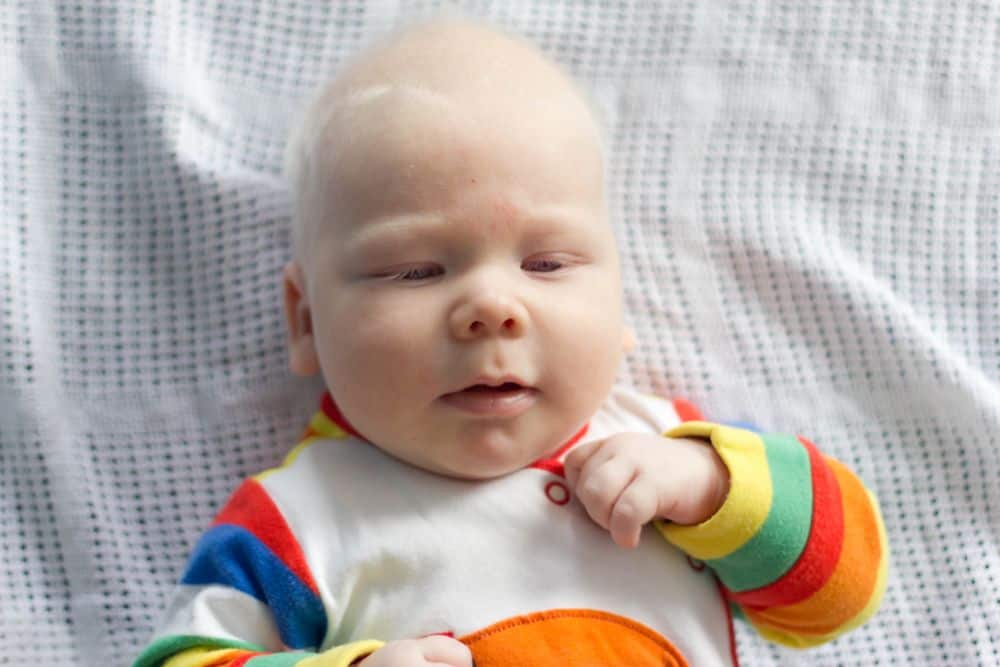
Albinism is a genetic condition that results in the absence of melanin in the hair, skin, and optics. People who have it are often characterized past having very fair peel and white hair. However, there are unlike variations.
The status is very mutual, especially in other parts of the world, where as many as 1 in 3,000 children are born with it. In the U.Due south., information technology affects about 1 in 18,000 to xx,000 people (8).
Albinism is not a condition your baby can acquire afterward birth, since it occurs due to a mutation in the genes. The chances that your baby will accept it are very slim.
More often than not, for a baby to be born with albinism, both the mother and father must conduct the mutated gene. However, further studies revealed that at that place is another variation where the mom is the carrier. This type usually only affects boys.
Albinism is non a life-threatening condition, merely information technology can cause poor vision. Fortunately, for the most part, this can be corrected.
Babies and children with albinism should be well protected from the dominicus at all times. Because their skin lacks pigmentation, they are extra sensitive and may hands become sunburnt. Applying sunblock and dressing them in opaque article of clothing, including hats and loose shirts, is essential.
It'due south non uncommon for some parents to worry about whether or not they will have a infant with albinism. If you lot are concerned, you tin hash out this with your doc.
In that location is no accented way of telling, since Dna samples vary, fifty-fifty for the same blazon of albinism. But you might be able to notice out if there's a slim chance.
Hair Today, Gone Tomorrow
Wondering which hair color your infant will have is a normal part of every pregnancy. Maybe y'all're hoping for a blond, or maybe y'all wish that your redhead genes will come through for another generation. I know I couldn't finish thinking about it!
But there are a lot of genes at play when it comes to pigmentation, and there's no way to tell for sure.
When Can You Tell a Baby's Hair Color
Source: https://momlovesbest.com/baby-hair-color
0 Response to "When Can You Tell a Baby's Hair Color"
Post a Comment